KG 2000 Polypropylene

Sewerage pipes and fittings made of polypropylene comply with ČSN EN 14758-1 and resist boiling water, light exposure and extreme storage conditions.

KG 2000 Polypropylene
KG 2000 Polypropylen

Description

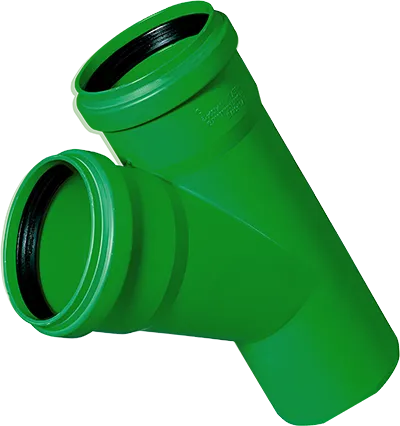
Sewerage pipes and fittings made of polypropylene comply with ČSN EN 14758-1 and resist boiling water, light exposure and extreme storage conditions. They are suitable for deep excavations, areas with high groundwater levels and places with heavy traffic loads, such as roads and motorway pavements.

KG 2000 Polypropylene – extremely durable sewerage system for demanding conditions

Sewerage pipes and fittings KG 2000 Polypropylene represent a powerful and exceptionally durable system made of polypropylene (PP), developed specifically for installation in demanding conditions. Compared to the classic KG system, they offer higher strength, toughness and reliability when installed at depth, in environments with high groundwater levels or under traffic loads.

Thanks to a homogeneous, smooth wall with high ring stiffness, KG 2000 pipes are ideal for locations with peak loads – from motorway and road surfaces, through industrial areas to extremely deep excavations. The system is designed to long-term resistance to mechanical stress, soil pressure and dynamic traffic loads, while maintaining excellent hydraulic properties.


Why choose KG 2000 Polypropylene

High strength classes SN 10 and SN 16

The resistance of the KG 2000 Polypropylene system is based on the reinforced homogeneous pipe wall, which provides ring stiffness SN 10 or SN 16.

This enables safe use:

  • in urban development
  • in city centers with high traffic load
  • in building foundations
  • in deep placement in demanding terrain

Pipes reliably withstand soil pressure and extreme operating conditions.

Water-tightness and gas-tightness verified by tests

KG 2000 Polypropylene system is designed for maximum operational safety. Piping is water-tight even under high load:

  • at 0.5 bar overpressure
  • at 0.03 bar underpressure
  • successful system tests in Darmstadt at 3.0 bar

The tightness of the entire system remains stable even under pressure load, soil movement or vibrations.

Perfectly tight joints with multi-edge sealing element

Joints of KG 2000 pipes are designed with a multi-edge sealing element that is engineered to long-term resist mechanical and chemical stress.

Sealing system contains:

  • tension blade – prevents contamination from entering between the seal and the pipe wall
  • spacing blade – precisely fixes the position of the inserted pipe
  • wiper blade – removes contamination during pipe insertion
  • main sealing blade – ensures long-term joint tightness

The result is a joint that remains tight even with installation deviations, vibrations and deformations caused by load.

Outstanding chemical, thermal and mechanical resistance

KG 2000 Polypropylene sewage system meets the requirements for operation in chemically or thermally stressed environments:

  • chemical resistance according to DIN 8078 from pH 2 (acidic water) up to pH 12 (alkaline water)
  • long-term thermal resistance up to 90 °C
  • resistance to erosion, corrosion and sedimentation thanks to low surface roughness 0.001 mm
  • high notch toughness ensuring stability even under significant mechanical stress

Thanks to these properties, KG 2000 is ideal for areas with extreme loads or risk of aggressive substances.

Presentation video

Presentation video

Documents

FAQ

Maximum operating temperatures of pipes, fittings and seals

Maximum operating temperatures can be found in the individual catalogues of waste and sewage systems and seals.

permanent temporary
90°C 95°C

Seals Areas of use - temperatures
SBR (at manufacturer/within the work) approx. -50°C to +100°C
EPDM approx. -50°C to +150°C
NBR (can be ordered separately) approx. -30°C to +100°C

SBR Improved wear resistance and aging, good resistance to operating fluids
EPDM Excellent resistance to wear, aging and most operating fluids
NBR Versatile material. Seals for contact with mineral oil or fuels. Poor resistance to ozone and weather effects.
Pipe behavior in case of fire

Pipes laid in the ground do not pose any fire load, therefore classification of sewage pipes is not necessary.

Chemical resistance of M.O.L. seals against "swimming pool water"

Seals of BL, DD and Euro L Spezial systems are resistant to water with a maximum chlorine content of 0.6 mg/l.

Can the dimensioning of a sewage/drainage system be reduced (narrowed) in the direction of flow?

No. This provision serves, among other things, to prevent the creation of (reverse) backwater and retained quantities within the system.

Is it permitted to shorten fittings?

It is not permitted.

Assignment of products to standards/certificates

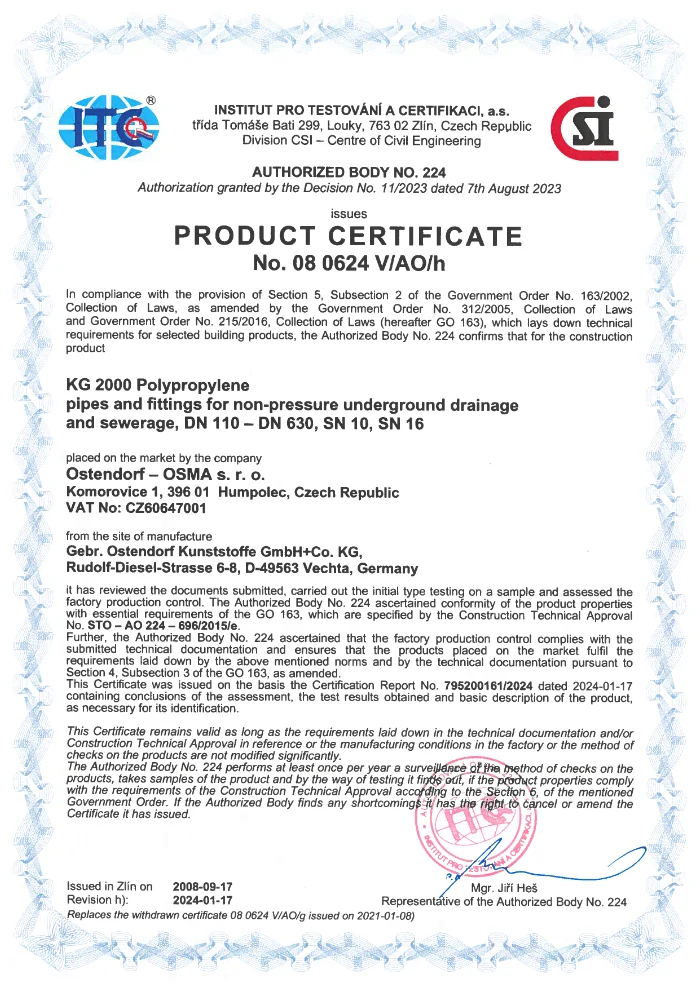
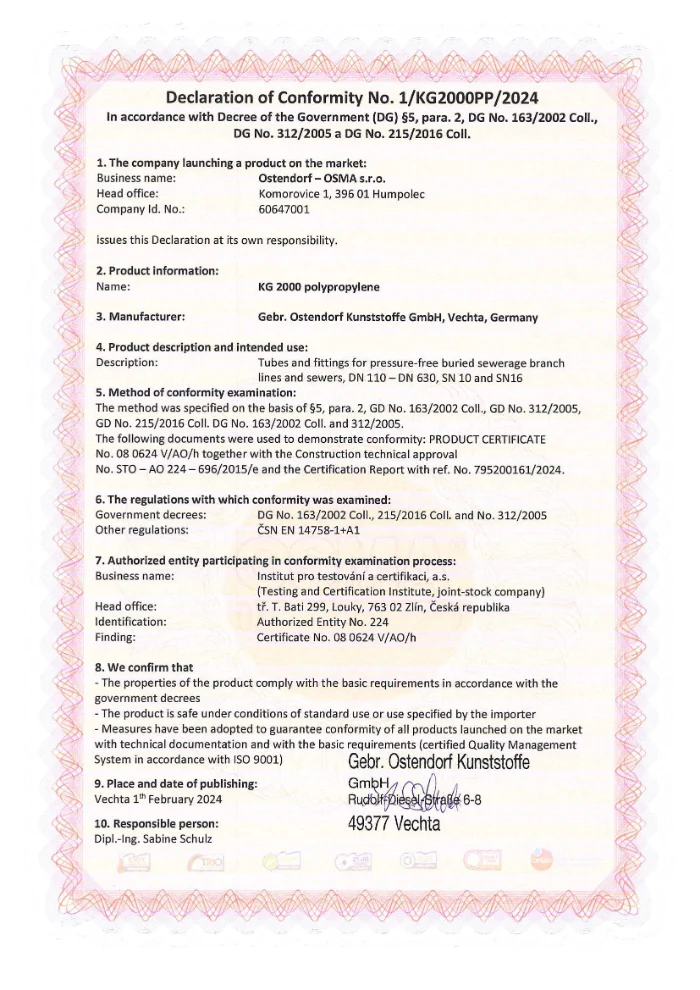
KG 2000 Polypropylene (DN 110 - DN 500) according to DIN EN 14758 standard

What are the dynamic ring stiffness values for KG-System (PVC)

They are manufactured with a minimum ring stiffness of 10 kN/m2 and 16 kN/m2.

Is it possible to combine rainwater and wastewater pipes in a building?

No. It is not permitted to combine rainwater and wastewater pipes inside a building. Pipes may only be diverted into a common pipe outside buildings (preferably close to the connection channel at the property boundary).

An exception becomes valid if it is a boundary building, then combining rainwater and wastewater pipes inside the building is also permissible.

Wastewater from pumping stations – can it be implemented with the KG-System (PVC) or KG 2000 Polypropylene system?

Yes, it is possible. Both systems can be used to discharge wastewater from pumping stations (oils, lubricants, glycol, methane, propane, butane, hydrocarbons, diesel, etc.), provided that NBR seals are used.

Minimum and maximum cover for KG 2000 Polypropylene system

As a house connection, pipe laid in the ground or connection channel and in areas with heavy loads (SLW 60), the minimum cover is 0.8 m.

Maximum cover: 6 m.

The height of permissible cover depends on a number of factors, and therefore in case of doubt, a static calculation using a program specially prepared for these purposes should be carried out. The technical staff of our company will be happy to perform the calculation for you.

Can KG 2000 Polypropylene be used for the purpose of "ground heat exchanger"?

We do not (yet) have any special certificate for this purpose of use. However, many of our customers have KG 2000 Polypropylene successfully used it as a ground heat exchanger pipe (in air). In any case, this is, however, a use for a different purpose. If you are interested in this question, you can visit the home pagewww.ag-solar.de.

Direction of installation of plastic pipes

Installation of pipes with insertion sockets/couplings is generally carried out so that the pointed end is in the direction of flow. The pointed end is inserted into the socket/coupling.

Quote from the plastic pipes manual (4th edition, section 3.4.4 Construction of sewers and wastewater pipes, page 463)


Based on this, the installation of pipes in the direction of flow is clearly defined.

Which system is suitable for wastewater containing fats (in canteens, large kitchens, industry, gastronomy, etc.)?

It is recommended sewage system KG 2000 Polypropylene for the "UD" area of use – under the foundation slab and outside the building in the ground. For internal waste (area of use "B") HT-System PLUS (PP) and Skolan SAFE dB with sealing rings made of NBR.